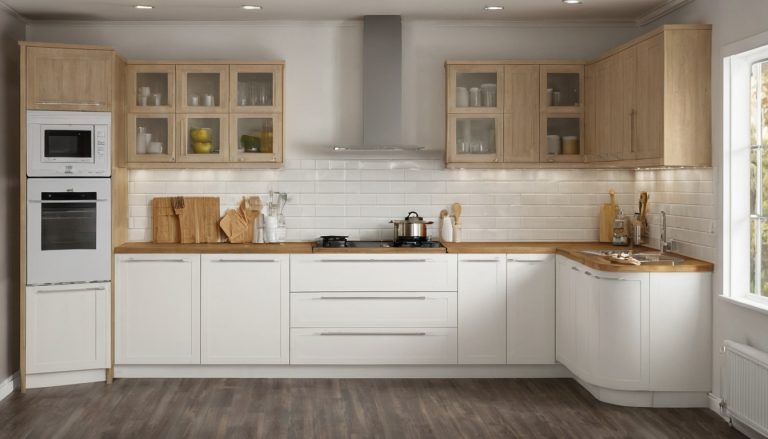
Country Kitchens in Hot, Dusty Climates: Which Details Age Well?
A country kitchen can become expensive maintenance if deep mouldings trap greasy dust, sunlight exposes fading, or moisture reaches poorly sealed cabinet edges. The safer approach is to buy restrained, washable and repairable assemblies, then add character only where cleaning access and climate control support it.
Which country-kitchen details age well in hot, dusty homes?
Country kitchens age best when character comes from shallow profiles, enclosed storage, durable finishes and replaceable hardware. Deep ornament increases dust retention and repeated wiping, which can accelerate coating wear.
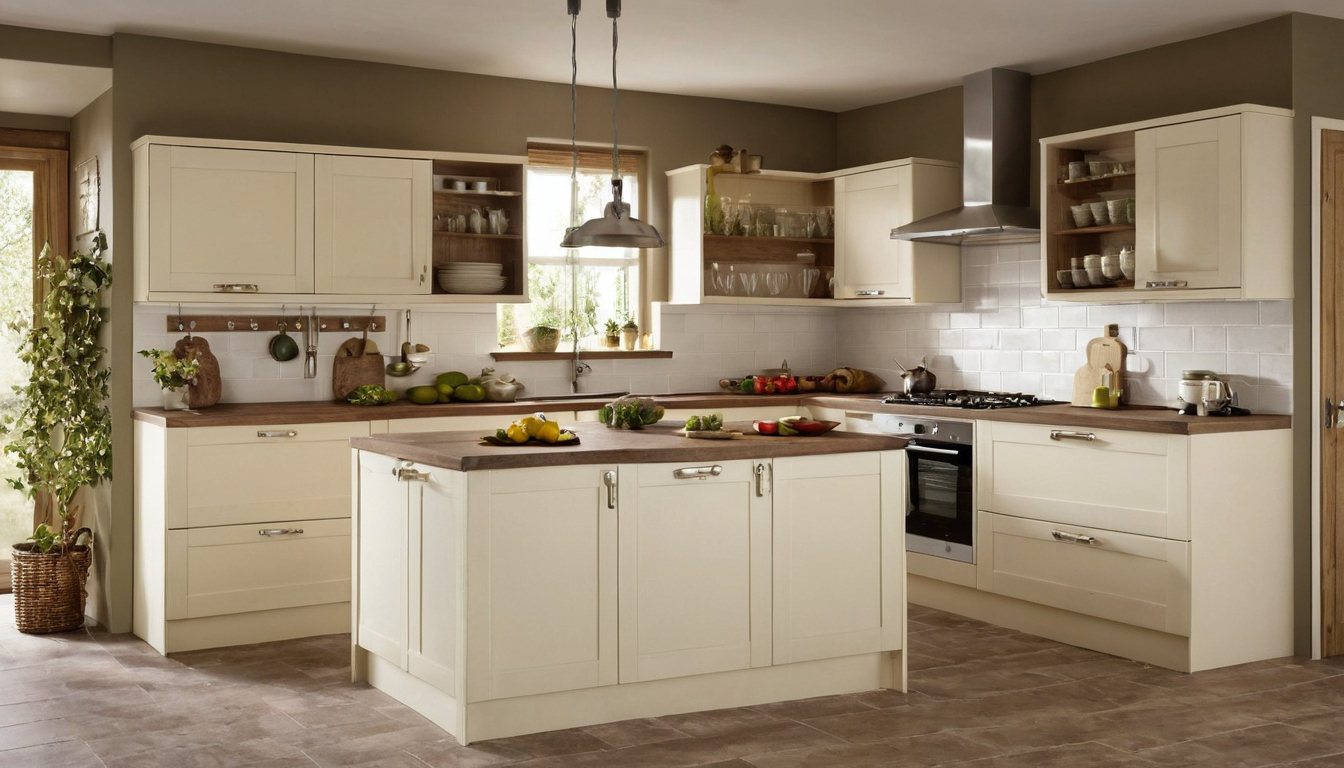
Which country-kitchen details age well in hot, dusty homes shown as an editorial planning reference.
Shallow profiles and enclosed storage provide country character with less dust retention
- Keep: shallow Shaker doors, simple hardware, enclosed cabinets, sealed worktops and low-texture tile.
- Modify: restrict open shelves, plate racks, beadboard and timber worktops to low-grease, low-splash areas.
- Avoid: layered cornices, inaccessible grooves and distressed finishes that cannot tolerate regular cleaning.
Country-kitchen patina is acceptable only when the homeowner chooses it deliberately
Timber mellowing and unlacquered metal tarnishing can be intentional. Veneer lifting, swollen joints, coating loss and corrosion are failures. The U.S. Environmental Protection Agency identifies paints, varnishes, waxes, cleaners, building materials and furnishings as potential indoor VOC sources and recommends increased ventilation while using emitting products. For valuable displayed objects, the National Park Service Museum Handbook offers conservative preservation guidance. Cabinet construction is the next durability test.
What should Shaker kitchen cabinets be made from in hot, dusty climates?
Shaker kitchen cabinets work when their geometry, substrate, edge sealing and finish suit the home’s humidity, sunlight and cleaning regime.
A shallow Shaker profile reduces ledges without losing the frame-and-panel effect
Require a full-size drawing showing frame width, recess depth, corner radius, panel construction and coating build-up. A cloth should reach every corner. Reject sharp grooves, misaligned joints and thin edge coverage.
Cabinet substrate selection must follow humidity control, water exposure, and repair strategy
Check local conditions rather than relying on a generic hot-climate label. NCEI recommends its 1991–2020 U.S. Climate Normals, first released in May 2021, with statistics for 23 sites reissued in 2023 as version 1.0.1. The ASHRAE Weather Data Center provides station discovery across handbook editions from 2001 through 2025, a 2025 viewer covering 12,424 stations, and identifies Standard 169 as a climatic-design resource.
| Assembly | Likely failure path | Evidence required before order | Repair route |
|---|---|---|---|
| Solid timber | Joint movement | Moisture range and coating | Refinish or remake |
| Veneer | Edge lifting | Core, adhesive and sealing | Replace panel |
| Plywood | Edge swelling | Grade and face quality | Patch or replace |
| MDF | Swollen penetrations | Classification and full sealing | Replace door |
| Particleboard | Water-damaged edges | Grade and sink detailing | Replace component |
| HPL | Seam delamination | Bond and edge specification | Replace facing or panel |
| TFL | Chipped edges | Board and edging quality | Re-edge or replace |
A cabinet finish should be accepted by test result and sample, not by sheen name
Request evidence for adhesion, abrasion, household chemicals, heat and color stability. Inspect sink cabinets, dishwasher sides, oven towers, toe kicks, handle holes and service penetrations. Coastal projects also need corrosion-suitable fasteners.
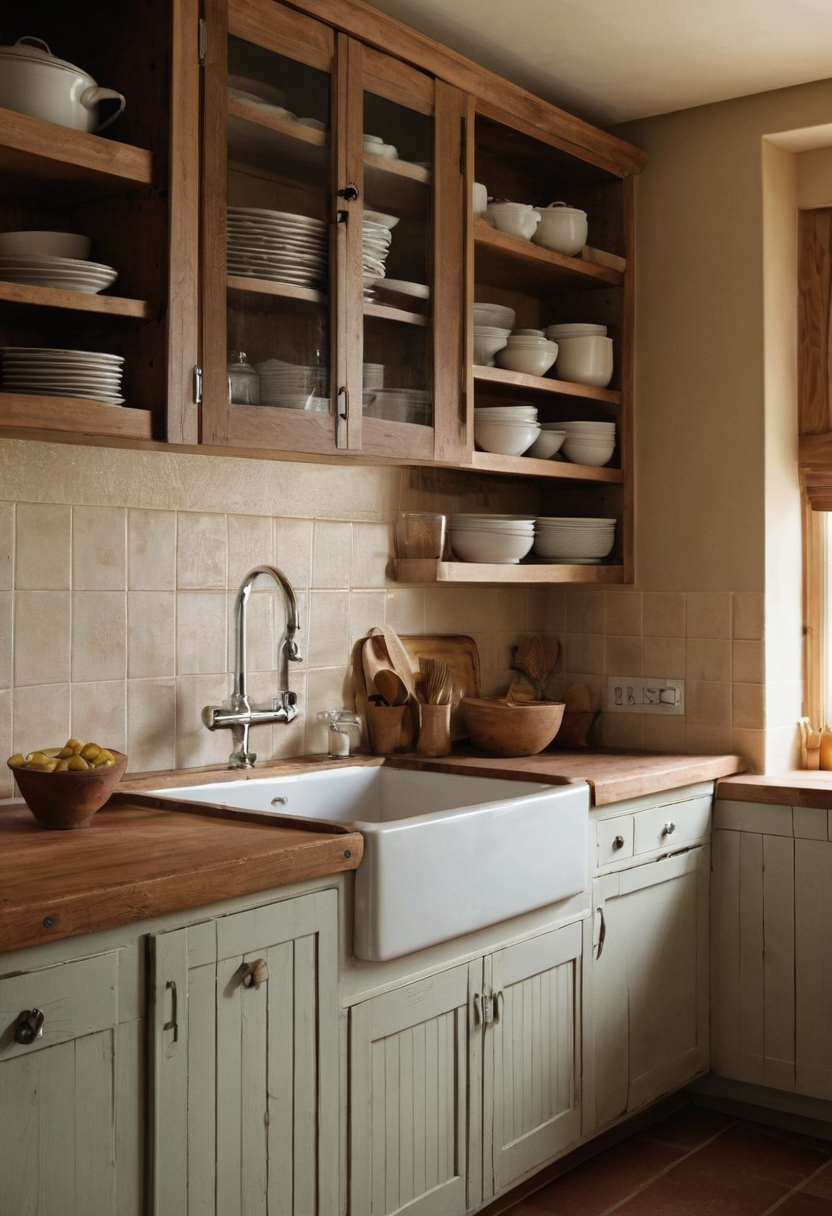
What should Shaker kitchen cabinets be made from in hot, dusty climates shown as an editorial planning reference.
Which colors, coatings, worktops, and splashbacks hide dust without aging badly?
Mid-light, low-chroma finishes often reduce contrast with settled dust, but no color succeeds without sunlight, cleaner and repair checks.
The best country-kitchen color balances dust visibility, daylight, and touch-up practicality
- Test the room: View large samples beside windows and under the specified task lighting. Qualified LED products can reduce operating demand; ENERGY STAR states that qualified LEDs use at least 75 percent less energy and last up to 25 times longer than incandescent lighting.
- Check exposure: Record orientation, glazing and shading. NCEI offers conventional 30-year and supplemental 15-year normals with annual, monthly, daily and hourly access, subject to station availability.
- Plan repairs: Obtain paint codes, sheen, touch-up instructions and replacement-door terms.
Low-texture splashbacks and well-planned seams reduce grease-bound dust
- Prefer smooth slabs or glazed tile near the hob over rough stone and deep grout joints.
- Approve sink cut-outs, corners, upstands and sealant positions before fabrication.
- Match cleaners to each material. The Natural Stone Institute recommends neutral cleaner, stone soap or mild detergent with warm water and warns against abrasive powders and creams.
Open shelving, ornate trim, and unlacquered hardware increase country-kitchen maintenance
Decorative details should wipe clean in one pass or be replaceable without remaking cabinetry.
Open shelves work best as a limited display zone away from grease and direct dust entry
- Low maintenance: enclosed cupboards, shallow doors and simple handles.
- Medium maintenance: short shelves for daily dishes, away from hobs, windows and air outlets.
- High maintenance: cornices, grooves, exposed cookware, latches, plate racks and fabric skirts.
Confirm shelf loads and wall fixings. Full-hand handles generally suit limited grip better than small knobs or stiff latches.
Lacquered or plated hardware is more predictable than a living finish
Specify the base metal, finish process, screws, cleaner restrictions, warranty and replacement availability. Tarnishing may be deliberate; pitting, seizure and coating loss are failures. Salt exposure raises the risk.
How should country-kitchen ventilation and cleaning control dust and grease?
A ducted hood, replacement air, HVAC filtration, controlled entry points and finish-safe cleaning must operate as one system.
A range hood must be selected as a complete capture and duct system
Match the hood to appliance width, fuel, cooking intensity and mounting limits. Review capture area, certified airflow, resistance, duct size, bends, discharge and noise. Recirculation does not replace outdoor exhaust. Local codes and appliance instructions take precedence.
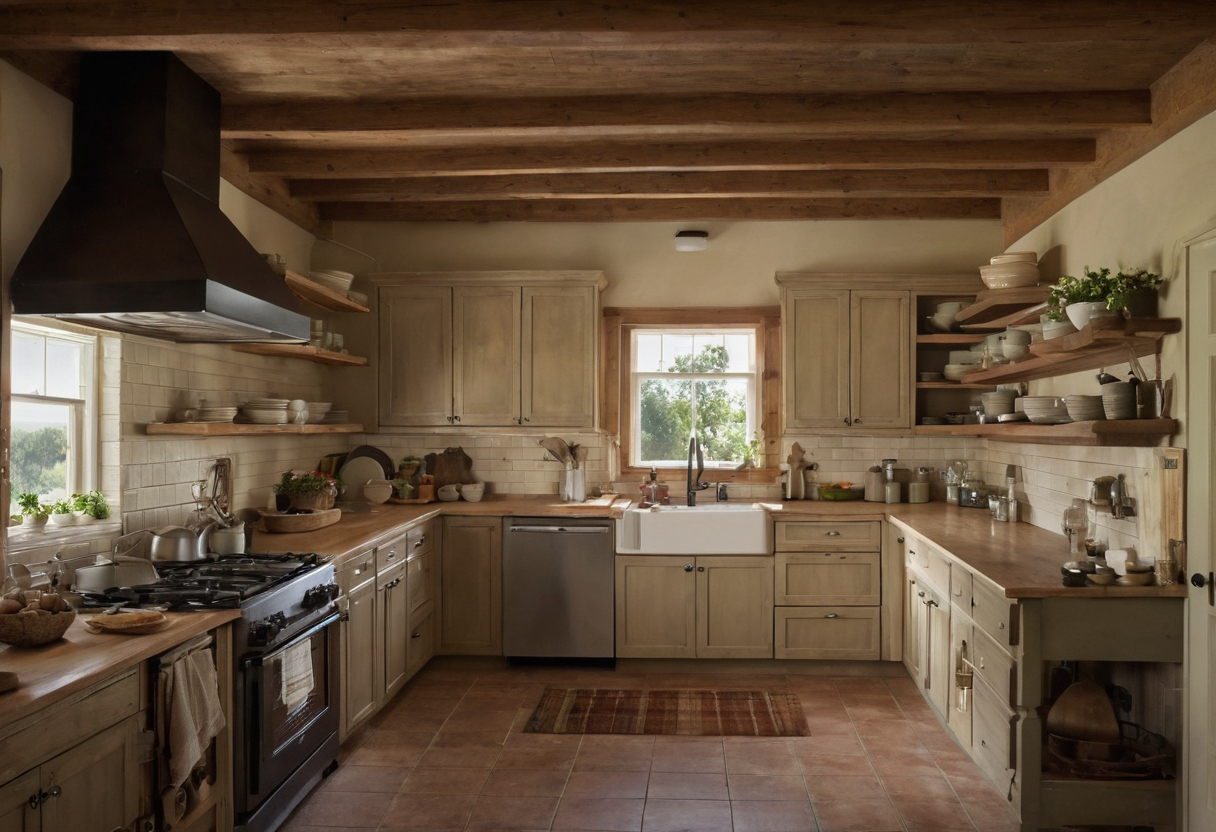
How should country-kitchen ventilation and cleaning control dust and grease shown as an editorial planning reference.
Air-conditioning filtration and entry control reduce outdoor dust at the source
An HVAC engineer should confirm filter efficiency, pressure drop, replacement intervals and room pressure. Strong extraction can draw dust through gaps. NCEI normals cover almost 15,000 U.S. stations, while ASHRAE offers simulation weather files for 3,012 locations outside the United States and Canada. ASHRAE’s 2021 climatic-design tables cover 9,237 worldwide locations, but project-specific engineering remains necessary.
A finish-safe cleaning plan should separate dry dust removal from grease removal
Remove loose dust with a soft cloth or suitable vacuum attachment before wet cleaning. Then use manufacturer-approved products, dilution and contact time. Dry joints promptly. The EPA moisture guide advises correcting condensation and damp spots promptly.
How should homeowners specify, test, budget, and install a durable country kitchen?
Buy the kitchen as a documented assembly, not a collection of attractive samples. Protect substrates, edge sealing, coatings, extraction, hardware and installation before ornament.
Full-size samples should undergo daylight, cleaner, grease, and handling checks before approval
Test a full-size door, hardware sample, worktop offcut and sealant color in the kitchen. Record the substrate, primer, topcoat, sheen, edge treatment, cleaner and acceptance criteria.
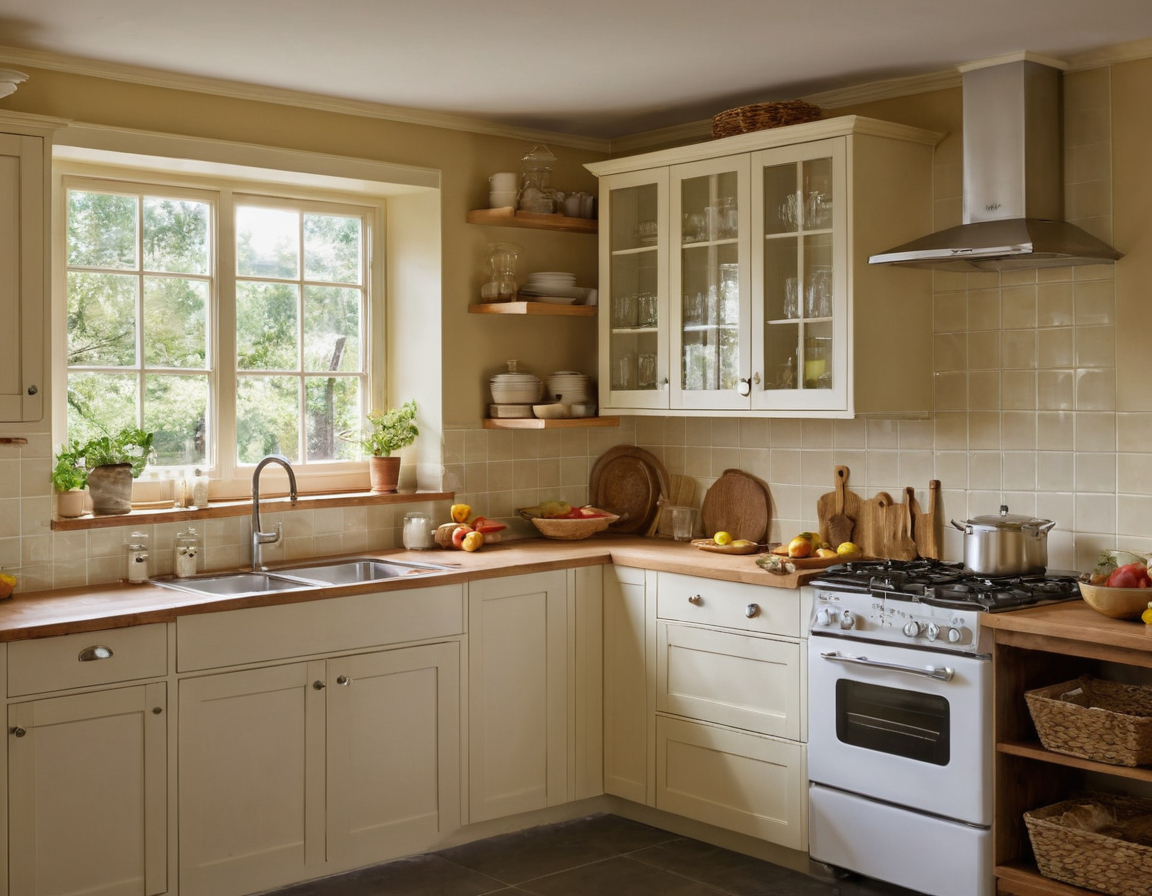
How should homeowners specify, test, budget, and install a durable country kitchen shown as an editorial planning reference.
Kitchen installation should follow ventilation, services, cabinets, surfaces, and final hardware in a controlled sequence
- Fix the layout, appliance clearances and access requirements. Where applicable, the 2010 ADA Standards specify a 30 by 48 inch clear floor space and accessible work surfaces 28 to 34 inches high.
- Tender identical specification levels using local prices.
- Approve signed samples before manufacture.
- Resolve plumbing, outlets, ducting, cooling and kitchen island pendant spacing and wiring decisions.
- Install and level cabinets, seal cut-outs, then template surfaces.
- Commission extraction and collect warranties, finish codes, spare hardware and care instructions.
A country-kitchen budget should prioritize hidden durability before visible decoration
Fund stable carcasses, sealed edges, documented coatings, reliable runners, ducting and skilled fitting first. Simplify cornices, open shelves, latches and paint effects rather than accepting a vulnerable cabinet system.
Frequently asked questions
Are country kitchens still in style in 2026?
Yes, if country character comes from proportion, timber and restrained Shaker detailing. Deep mouldings and artificial distressing can appear dated and demand more cleaning.
Which cabinet color hides pale dust and fingerprints?
Mid-light, low-chroma colors often reduce contrast, but test large samples under the room’s daylight and task lighting.
Are Shaker kitchen cabinets practical with intermittent air conditioning?
Yes, if profiles are shallow and substrates, joints, edges and penetrations are fully specified for expected humidity movement.
Can a small country kitchen use open shelving?
Use one short shelf for frequently washed items, away from the hob, windows and exterior doors.
Is unlacquered brass suitable for dusty or coastal kitchens?
Only if visible patina and regular care are acceptable. Choose a plated or lacquered finish when predictable color and lower maintenance matter more.